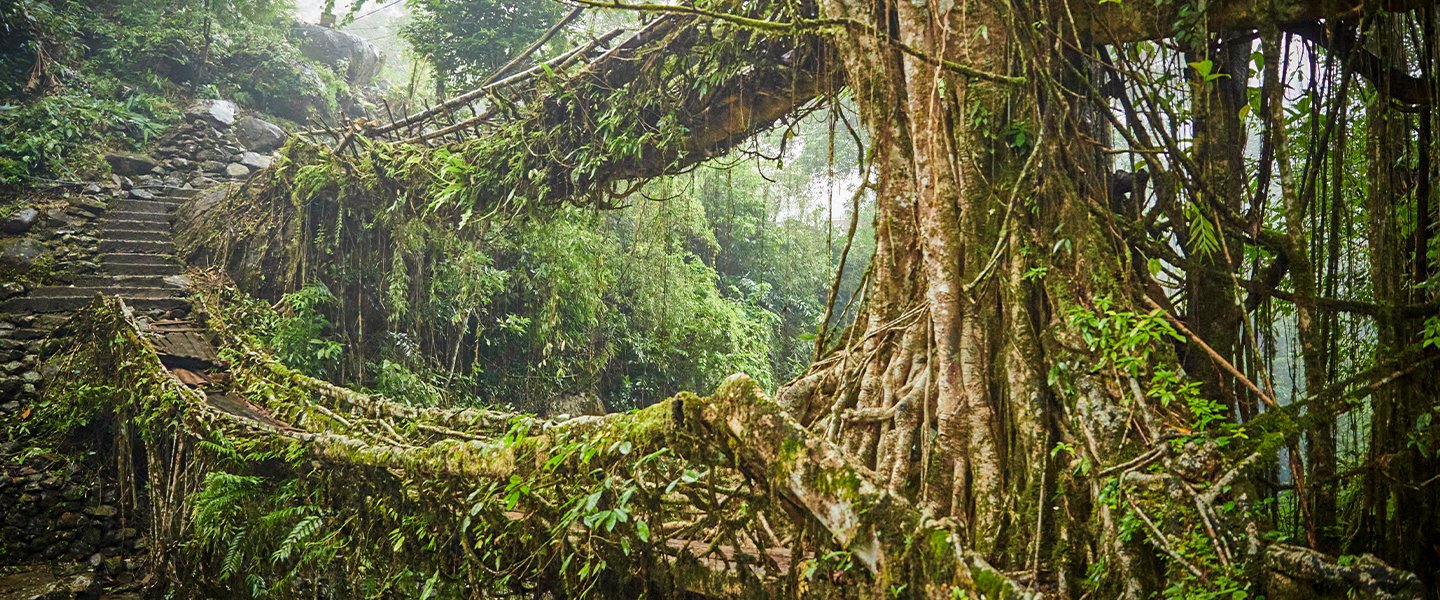
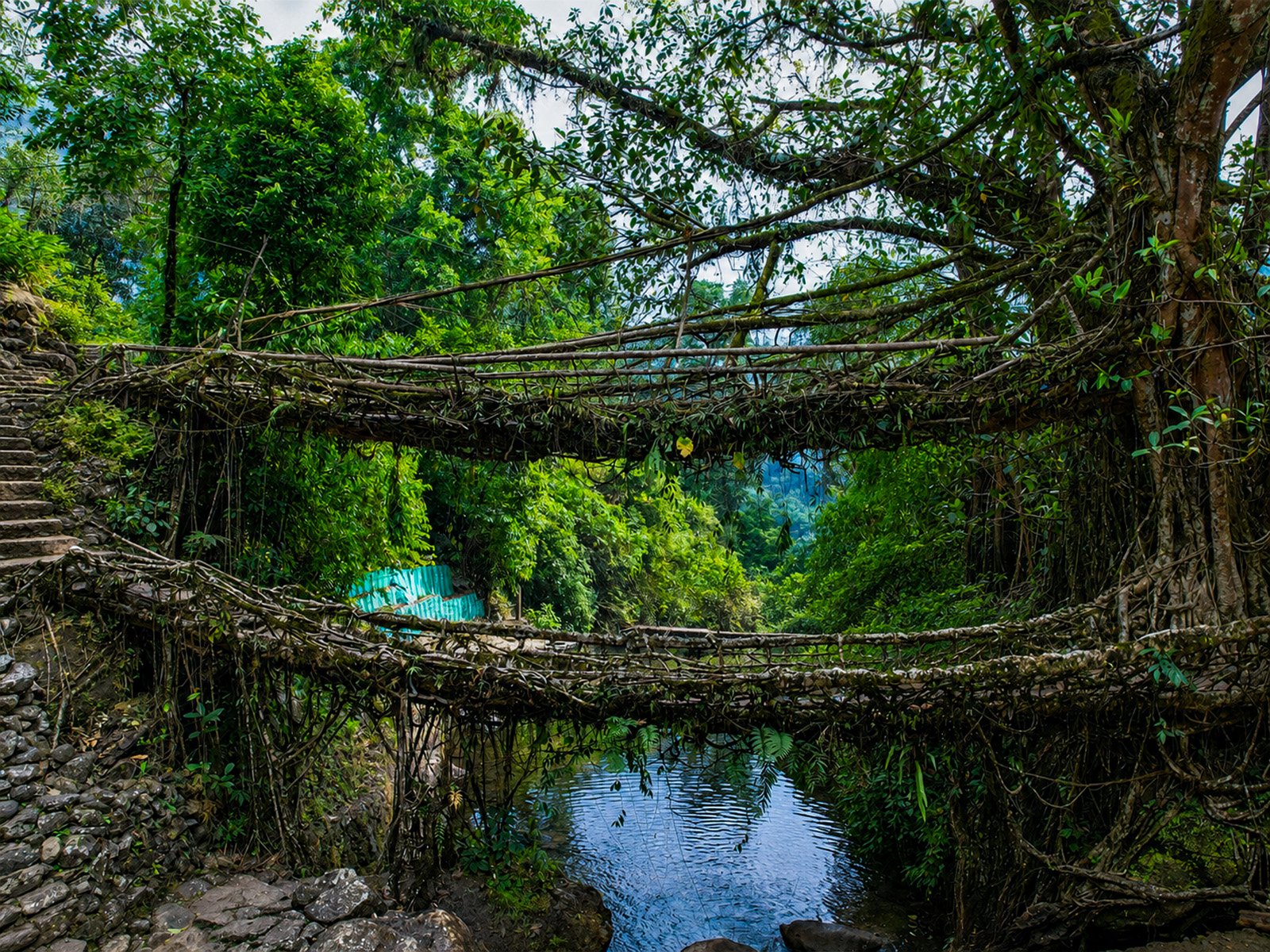
Hidden deep inside the lush forests of Meghalaya’s East Khasi Hills, the Double Decker Living Root Bridge at Nongriat is one of India’s most remarkable examples of traditional ecological engineering. Unlike conventional bridges made from concrete, steel, or wood, this extraordinary structure is created from the living roots of rubber fig trees.
The bridge is not simply a tourist attraction. It represents generations of Khasi knowledge, patience, craftsmanship, and a unique relationship between people and nature. For travelers planning a Meghalaya Tour Package, visiting Nongriat offers much more than a sightseeing stop—it is an opportunity to experience one of Meghalaya’s most distinctive cultural and natural landscapes.
What Is the Double Decker Living Root Bridge?
The Double Decker Living Root Bridge is a two-level bridge made by guiding and weaving the aerial roots of the rubber fig tree, Ficus elastica, across a natural watercourse.
The roots are gradually trained in the desired direction and supported while they grow. Over many years, the roots become thicker, stronger, and increasingly interconnected. The resulting structure can eventually support people while continuing to remain alive and grow.
This makes the bridge fundamentally different from an ordinary man-made structure. A concrete bridge is constructed first and then maintained as it ages. A living root bridge develops gradually and can become stronger as its root network matures.
Meghalaya’s Biodiversity Board describes living root bridges as structures developed by indigenous Khasi communities over approximately 15–30 years and notes their potential to survive for centuries under suitable conditions.
History of Living Root Bridges in Meghalaya
The history of living root bridges is closely connected with the traditional lifestyle of the Khasi people.
The Khasi Hills receive extremely heavy rainfall, and many streams and rivers become difficult to cross during the monsoon. In a landscape dominated by steep valleys, dense forests, and fast-flowing waterways, communities developed practical ways to connect villages and walking routes.
Rather than cutting down trees and constructing temporary crossings, Khasi communities learned how to guide the naturally growing aerial roots of rubber fig trees.
The exact age of the Double Decker Bridge at Nongriat is difficult to establish with certainty. However, the living-root-bridge tradition itself is centuries old, and knowledge of creating and maintaining these structures has been passed from one generation to another. Meghalaya Tourism describes the root bridges as an integral part of the old Khasi way of life, particularly in an environment where people traditionally travelled through forests and crossed fast-flowing rivers on foot.
This distinction is important: the bridge is not an ancient stone monument built at one specific point in history. It is a living structure whose development and maintenance happen over generations.
Where Is the Double Decker Root Bridge?
The Double Decker Living Root Bridge is located at Nongriat village in the East Khasi Hills district of Meghalaya.
The nearest major tourist centre is Sohra (Cherrapunji), approximately 15 km away. Vehicles can take travelers from Sohra toward Tyrna village, where the road journey ends and the trek begins.
Meghalaya Tourism currently describes the trek from Tyrna to Nongriat as involving roughly 3,000 to 3,500 stone steps, depending on the route description. The descent takes travelers through forested terrain, across bridges and streams, and deeper into the Nongriat valley.
From Shillong, Meghalaya Tourism lists Nongriat at roughly 65 km by road.
Meghalaya Tourism: Must-Visit Places on Your Trip
Meghalaya has become one of Northeast India’s most popular destinations for travelers looking for waterfalls, living root bridges, green valleys, forests, caves, and unique local culture. Among its many attractions, the Double Decker Living Root Bridge at Nongriat has become one of the state’s most recognizable natural and cultural landmarks. Its unique living-root construction and the adventurous trek required to reach it make it a memorable highlight of any Meghalaya Tour Package.
However, the Double Decker Root Bridge is only one part of the Meghalaya experience. A well-planned Meghalaya Trip can combine Nongriat with several other scenic destinations across the state.
Mawlynnong
Known for its scenic surroundings and village atmosphere, Mawlynnong is one of Meghalaya’s well-known tourist destinations. Located in the East Khasi Hills, the village offers beautiful views, lush greenery, walking trails, and an opportunity to experience rural Khasi life. It can be combined with other attractions in the region for travelers exploring Meghalaya.
Nohkalikai Falls
Located near Sohra (Cherrapunji), Nohkalikai Falls is one of Meghalaya’s most spectacular waterfalls. The water plunges dramatically from a forested plateau into a deep blue-green pool below. Its impressive height and surrounding landscape make it one of the must-see attractions to include in a Meghalaya Tour.
Dawki
Situated close to the India-Bangladesh border, Dawki is famous for the crystal-clear waters of the Umngot River. Visitors can enjoy the scenic river landscape, boating, and views of the surrounding hills. Dawki is a popular addition to meghalaya tour packages and can be combined with nearby destinations such as Shnongpdeng and Mawlynnong.
Grand Laitlum
Grand Laitlum, near Shillong, is known for its dramatic rolling hills, deep valleys, and panoramic viewpoints. The peaceful landscape makes it an excellent place for travelers who want to experience Meghalaya’s natural beauty away from busy tourist areas. The viewpoint is especially attractive for photography and nature lovers.
Shillong
The capital of Meghalaya, Shillong, is often the starting point for a Meghalaya Trip. Known for its pleasant climate, green hills, waterfalls, viewpoints, markets, and vibrant local culture, Shillong provides a convenient base for exploring different parts of the state. Travelers can begin their journey here before heading toward Sohra, Nongriat, Dawki, Mawlynnong, and other destinations.
The Trek to the Double Decker Root Bridge
The trek is an essential part of the experience.
You cannot drive directly to the Double Decker Root Bridge. The journey begins at Tyrna, followed by a steep descent through the forest.
The trail includes:
- Thousands of stone steps
- Dense subtropical forest
- Small streams
- Suspension bridges
- Traditional village landscapes
- Natural pools
- Smaller living root bridges
- Waterfalls and scenic viewpoints
The descent can be physically demanding, but the surroundings make the journey as memorable as the destination itself.
The return journey is particularly challenging because travelers must climb back up the steps they descended earlier. Meghalaya Tourism recommends allowing sufficient time and notes that an overnight stay in Nongriat can be a better option for travelers who want to explore the area without rushing.
Why Are Living Root Bridges Environmentally Important?
Living root bridges provide an interesting alternative to conventional infrastructure.
Research from the Meghalaya Biodiversity Board identifies several ecological and social advantages associated with living root bridges, including their ability to withstand challenging climatic conditions, their contribution to surrounding ecosystems, and their long-term relationship between human communities and plant life.
Because the bridge itself is alive, its relationship with the surrounding ecosystem is fundamentally different from that of a concrete structure.
The roots can continue growing, reinforcing the bridge and becoming integrated with the forest environment.
This makes the living root bridge an excellent example of nature-based engineering and community-led adaptation.
Current Situation of the Double Decker Root Bridge
As of 2026, the Double Decker Living Root Bridge remains an active tourism attraction promoted by Meghalaya Tourism. Official tourism information continues to recommend Nongriat for trekking, nature, culture, and traditional practices.
The official tourism guidance currently recommends September to March as the preferred period for visiting because the drier season generally provides better trekking conditions.
However, travelers should remember that Meghalaya is a high-rainfall destination. During wet conditions, the stone steps and forest trails can become slippery, while heavy rain can affect streams and trekking conditions.
The Meghalaya Tourism Department advises visitors during the monsoon period to carry waterproof bags, waterproof jackets, anti-slip footwear, quick-drying clothes, and to check weather forecasts for heavy rain and landslide warnings.
For the latest travel conditions, visitors should always check official local guidance before beginning the trek.
Why Include the Double Decker Root Bridge in Your Meghalaya Tour Package?
A Meghalaya Tour Package is often associated with waterfalls, caves, viewpoints, forests, and crystal-clear rivers. But the Double Decker Living Root Bridge offers something different.
It combines:
- Adventure
- Trekking
- Nature
- Khasi culture
- Traditional engineering
- Wildlife and forests
- Waterfalls
- Sustainable tourism
- Local community experiences
That combination makes Nongriat one of the most memorable experiences to include in a Meghalaya Trip.
Plan Your Meghalaya Trip with India On Wheelz
Make the Double Decker Living Root Bridge part of your Meghalaya adventure with India On Wheelz. Explore Meghalaya’s forests, waterfalls, caves, villages, living root bridges, and scenic mountain landscapes through a thoughtfully planned Meghalaya Tour Package.
Whether you are looking for a short Meghalaya Trip or a longer journey across the state, Nongriat is an experience worth adding to your route.